Most people discover yoga at a studio. Some discover it at 3,500 metres, just before the trail starts climbing again.
A yoga trek in Nepal is a walking journey where yoga, meditation, and breathwork are woven into the daily rhythm of the trek. The practice responds to altitude, exertion, and landscape in ways that an urban yoga class cannot replicate.
What a yoga trek actually looks like
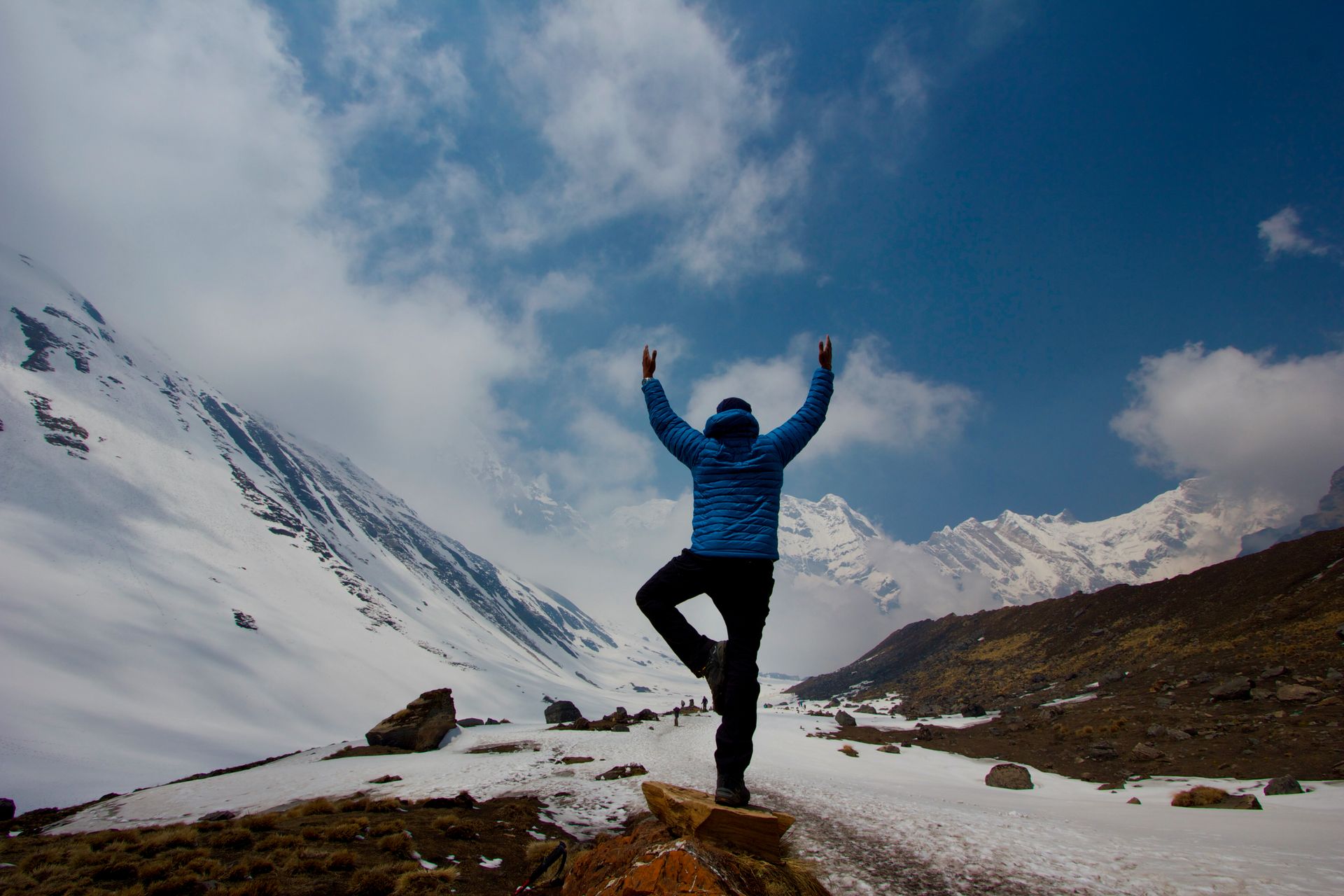
Each day follows a structure. The morning begins before breakfast: thirty to sixty minutes of practice adapted to the altitude and the previous day’s effort. At lower elevations, this might be a full Hatha or Vinyasa sequence. At 4,000 metres, it is more likely pranayama and gentle stretching focused on opening the chest and steadying the breath.
The trek itself happens in the middle of the day. At natural rest points, particularly near water or with clear mountain views, the guide may call a short stop for seated meditation or mindful observation. Not a photographic pause. An intentional break in forward motion.
Afternoons, after the day’s walking is done and teahouse rooms are settled, bring the second session: restorative yoga to address the demands of a long descent or a high-altitude push. Yoga nidra, a guided relaxation practice, is common in the evening as a way of helping the body process the day’s exertion.
TripAdvisor reviewers who have completed this format describe the cumulative effect as something they did not fully anticipate. One participant told us the practice changed the way she moved on the trail by day four: she was breathing deliberately on ascents rather than just enduring them, and she found she needed fewer stops on the climbs.
Why yoga and altitude are well matched
The connection between pranayama and high-altitude trekking is not incidental. Breath control has measurable effects on oxygen utilisation and the nervous system response to exertion. Trekkers who arrive with no yoga background typically develop a working pranayama practice within two or three days under guidance, and notice the difference when the trail climbs.
Hari Dharel, who founded Destiny Excursion’s Yoga Trek program after more than three decades guiding in the Himalayas, has observed that most of the difficulty trekkers encounter above 3,500 metres is not purely physical. It is the combination of altitude-induced fatigue and the mental friction of slow progress. Yoga gives the mind something to do with that experience rather than resist it.
The physical benefits are concrete. Daily stretching keeps the hip flexors and hamstrings functional across two weeks of sustained effort. Restorative practice reduces recovery time between demanding days. Trekkers on yoga treks consistently report less muscular soreness than on standard itineraries of comparable difficulty.
The routes that work best
Not every trekking route suits this format. The daily schedule of morning and evening sessions requires an itinerary that is not compressed or rushed. Routes with gradual altitude gain and reliable teahouse infrastructure work best.
Annapurna Sanctuary is the most popular choice. The approach through the Modi Khola valley is forested and sheltered, with manageable daily distances and a dramatic arrival at the Annapurna South glacier as the route’s centrepiece. The trek reaches 4,130 metres at the Sanctuary itself, high enough for altitude to be a real factor in the practice, but accessible to trekkers without technical climbing experience.
Poon Hill is the right route for first-time trekkers or those with limited time. Maximum altitude of 3,210 metres. A six to eight day itinerary allows space for the practice without requiring weeks away from work.
The Manaslu Circuit suits trekkers who have prior Himalayan experience. The route crosses Larkya La at 5,106 metres, making breath control at altitude genuinely relevant rather than aspirational. Trekkers on Destiny Excursion’s Manaslu yoga program have described the crossing of Larkya La as significantly different when two weeks of daily breathwork are behind you: the pass becomes an application of the practice rather than a test of endurance.
What to know before you go
You do not need prior yoga experience. The practice is adapted to participants rather than delivered as a fixed curriculum. What you do need is a reasonable level of fitness, an openness to trying something unfamiliar, and patience to move at a slower pace than a standard trekking itinerary.
Teahouse accommodation on yoga treks is basic. The rooms are the same as any trekking itinerary on these routes: shared or private depending on availability, a communal dining area, basic bathroom facilities. The yoga practice does not change the infrastructure. Reviewers describe the teahouse conditions honestly: basic, functional, and considerably easier to accept by day three or four, once the rhythm of the trek takes over.
Pack a lightweight travel yoga mat. Teahouses rarely have them, and session surfaces range from wooden dining room floors to cleared flat ground with a mountain view. Both work. A mat you are accustomed to makes the difference to your practice.
The best seasons are October to November and March to May. The morning practice in Nepal in October, at 3,000 metres, in still air with Himalayan peaks catching the first light, is what most yoga trekkers describe when they explain why they went back.
Is a yoga trek right for you
If you want a structured retreat with predictable comfort, yoga trekking is not the right format. Teahouse trekking is physically demanding and genuinely remote. But if you are looking for something that uses the trek as material for the practice, and the practice as support for the trek, the format offers something that neither activity provides on its own.
Destiny Excursion runs Yoga Trek programs on the Annapurna Sanctuary, Poon Hill, and Manaslu Circuit routes. Groups are kept small to allow the instructor to work with individual practice. All programs are led by guides holding both trekking qualifications and yoga certification.
Practical details
Durations: Poon Hill yoga trek 6-8 days. Annapurna Sanctuary yoga trek 12-14 days. Manaslu Circuit yoga trek 16-18 days.
Season: October to November and March to May.
Fitness: Moderate to moderate-high depending on route.
Group size: Maximum 8-10 trekkers to allow personalised instruction.
Yoga instructor: Certified, with high-altitude trekking experience alongside formal yoga training.