The park guide puts his hand flat in the air: stop. Twenty feet ahead, through the grass, a greater one-horned rhino stands with his back turned. You can make out the armoured plates along his spine and the single horn. He knows you are there. After a long moment, he moves off into the undergrowth without hurrying. Your guide exhales, then keeps walking.
That is what a Nepal Chitwan national park safari actually looks like. Not guaranteed, but probable. This guide covers the safari types, what wildlife you can realistically expect, the best time to visit, how to get there, what it costs, and what to bring so you do not spend the afternoon rationing your water.
Why Chitwan is worth the detour
Nepal is famous for mountains. Chitwan is the other Nepal. At 932 square kilometres, the park sits in the subtropical lowlands of the Terai, a two-climate change from Kathmandu. It became Nepal’s first national park in 1973 and a UNESCO World Heritage Site in 1984.
More than 700 greater one-horned rhinos now live here. In the early 1970s, fewer than 100 remained. That kind of turnaround does not happen in many places. The park also holds over 680 species of birds, roughly 250 Bengal tigers, gharial crocodiles, wild elephants, and leopards.
Safari types in Chitwan national park
Jeep safari
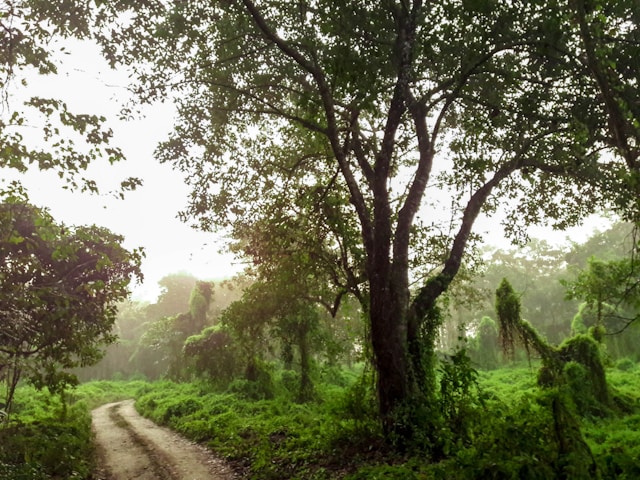
The most popular option, and the most practical for first-time visitors. A jeep covers more ground in three to four hours than a walking group can manage in the same time, which matters in a 932 km2 park. Most operators run morning slots (6am to 9am) and afternoon slots (3pm to 6pm). Core zone access, further inside the park, carries a slightly higher fee but puts you in denser wildlife territory. Book a morning jeep into the core zone if rhinos are the priority and you want a reliable outcome.
Walking safari
The most intense format, and the one that produces the closest encounters. A naturalist guide walks ahead. You follow in single file and stay quiet. When something crosses the path, everyone stops.
A traveller told us she spotted a rhino within twenty feet on a walking safari outside Sauraha, close enough to see the individual folds of skin along the animal’s neck. That does not happen from a jeep.
It is not for everyone. On one walking tour, half the group became visibly anxious when they heard a loud crashing sound in the forest ahead. The sound turned out to be a birth at a nearby breeding centre, not a charging animal. But the point holds: on a walking safari, you are inside the park. If large animals at close range make you nervous, the jeep is the better choice.
Canoe safari
A dugout canoe, hand-carved from a single tree, drifts along the Rapti or Narayani River. The boats are narrow and unstable. One traveller left her camera bag at the lodge after watching the canoe move, bringing a phone instead. A reasonable call.
What you see from river level is different from what you see on land: gharial and mugger crocodiles on the banks, Gangetic river dolphins surfacing mid-current, water birds that rarely appear in the forest. On the right trip, something more unexpected. One visitor watched a Bengal tiger track their canoe for four minutes along the riverbank, weaving in and out of the bushes, keeping pace with the boat. That was one trip out of many. It is possible.
A note on elephant safaris
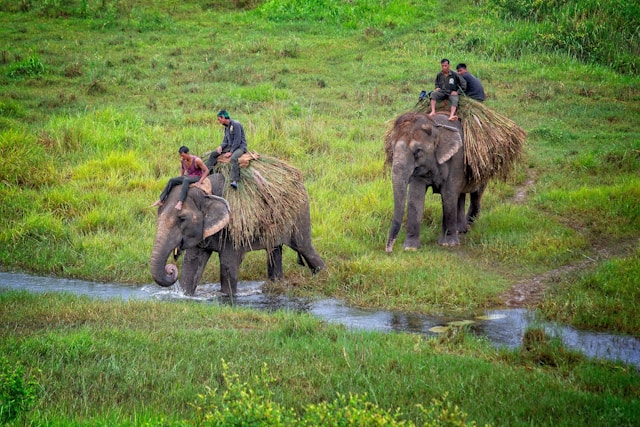
Elephant rides were once common at Chitwan. Legitimate operators do not offer them now. If a company does, find a different company.
Wildlife you can realistically expect to see
You will almost certainly see a greater one-horned rhino. You will very likely see gharial and mugger crocodiles near the river. You will definitely see spotted deer, sambar deer, wild boar, and rhesus monkeys. You may see a sloth bear, a leopard, or a wild elephant. A Bengal tiger sighting is possible but unlikely.
That is not a criticism of Chitwan. It is the reality of a 932 km2 subtropical forest with dense grass and thick vegetation. Most of the park’s 250 tigers are heard before they are seen. Animals can be three metres off the trail and invisible behind the grass.
There is one exception. In February, park workers burn sections of the tall elephant grass to encourage regrowth. For the weeks following a burn, sight lines open across the park. Rhinos, deer, and animals that spent months hidden behind four-metre grass become visible from the jeep tracks and walking trails. Most operators will not mention this when you book. If wildlife is the reason you are visiting Chitwan, February is the month to come.
Best time to visit Chitwan national park
October through March is the dry season: clear conditions, manageable temperatures, and reliable trail access. December and January mornings are cool, which slows animal activity slightly, but the dry ground keeps the park’s roads and paths open.
February stands out. After the grass burns, sight lines across the park open dramatically for several weeks. It is the single best month for wildlife visibility, and the one detail most operators do not mention upfront.
April and May are hot. The heat pushes animals toward water sources, which concentrates sightings around rivers and waterholes. The tradeoff is real humidity. One traveller who walked the safari in these conditions told us she brought what she thought were adequate water supplies and was rationing them before midday.
June through September is monsoon season. Rivers rise quickly and park trails can flood and close. Some visitors arrive to find access suspended for several days. Come for the monsoon if you want the jungle at its greenest. Come at another time if you want to see wildlife.
Getting to Chitwan from Kathmandu and Pokhara
Chitwan sits roughly 160 km south of Kathmandu. The fastest route is by plane: the flight from Tribhuvan International to Bharatpur Airport takes 25 minutes and operates daily on Buddha Air, Yeti Airlines, and Shree Airlines. One-way tickets typically range from NPR 9,000 to NPR 15,000 depending on when you book.
The tourist bus takes five to six hours and costs around NPR 1,000 to 1,500 each way. Buses leave from Thamel in the morning and drop passengers directly at Sauraha, the main gateway town for the park.
From Pokhara, the journey is four to five hours by tourist bus. If you are combining Chitwan with Pokhara, see our guide to what Pokhara tour packages include. Sauraha is the standard arrival point in both cases. Most accommodation and operators are based here.
What it actually costs
Park entry for foreign nationals: NPR 2,000 per person per day (approximately USD 15). SAARC nationals: NPR 1,000. Children under ten: free.
Package costs vary. A 1-night/2-day package covering accommodation, meals, park entry, and activities typically runs USD 120 to 180 per person. A 2-night/3-day package runs USD 180 to 300 and above. Three things move the price: the lodge tier (budget guesthouse to riverside jungle resort), whether the itinerary includes core zone access, and whether the jeep is shared or private.
A shared jeep and a mid-range lodge is the right call for most people. You get a guide with a smaller group than a budget bus tour, solid coverage, and a price that does not require justification when you look at the day.
What to pack for a Chitwan safari
Neutral colours only. Earth tones, olive, khaki, beige. One traveller packed only bright red and black trousers and realised the problem at the start of the walk, when her guide explained that strong colours disturb animals before you are close enough to see them. Most guides cover this in the pre-safari briefing. Arrive knowing it.
Water: more than you think you need. Three litres is a reasonable minimum for a morning jeep or walking safari. The humidity inside the forest is noticeably higher than outside. Two large bottles ran out before lunch for one traveller who had considered them sufficient.
Also bring: insect repellent, a wide-brim hat, a light long-sleeved shirt for the early morning start, closed shoes for walking safaris. Leave the perfume at the hotel.
Book your Chitwan safari with Destiny Excursion
Destiny Excursion runs 2-day and 3-day Chitwan safari packages including accommodation in Sauraha, park permits, jeep safari, canoe trip on the Rapti River, and guided walking with a trained naturalist. Chitwan can be combined with Kathmandu, Pokhara, or a trekking extension as part of a longer Nepal itinerary.
If you are planning the trekking side of your trip, the Everest Base Camp cost guide covers what to budget, what a standard package includes, and what most people book separately: How much does the Everest Base Camp trek cost?
View our Chitwan safari packages to see current itineraries and pricing.